How to Write a Tech Pack for Knitted Scarves & Beanies

How to Write a Tech Pack for Knitted Scarves & Beanies
You have a great scarf design in your head. But how do you explain it to a factory so they produce exactly what you want — not something close, not something similar, but exactly your design?
A Tech Pack (technical package) is the answer. It is the blueprint that tells your factory everything: measurements, materials, construction, labeling, and quality standards. This guide shows you exactly what to include.
1. What is a Tech Pack?
A tech pack is a document that contains all technical specifications for your product. Factories use it to quote prices, source materials, and produce your order. Without a tech pack, you rely on guesswork and verbal promises — which leads to mistakes, disputes, and bad products.
- Accurate quotes — factory knows exactly what you need
- Faster sampling — less back and forth
- Consistent quality — same specs every time
- Legal protection — written proof of requirements
2. Tech Pack Sections (What to Include)
Section 1: Product Basics
- Product name: e.g., "Classic Rib Knit Scarf"
- Style number: Your internal reference (e.g., WE-SC-001)
- Season / collection: e.g., AW2025 (Autumn/Winter 2025)
- Target price: Your target FOB price per piece
- Target MOQ: Minimum order quantity per color/SKU
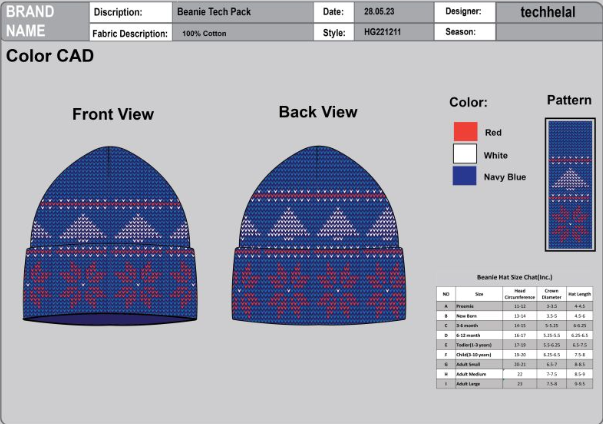
Section 2: Technical Sketch (Flat Drawing)
- Front view of the product
- Back view (if different)
- Side view (for beanies, hats)
- Callouts for key features (stitch type, trim, label placement)
Section 3: Measurement Specification
- Point of measurement diagram (where to measure)
- Measurement table with tolerances
- Size grading (if multiple sizes)
Scarf Measurement Table Example
| Measurement Point | Spec (cm) | Tolerance (±cm) |
|---|---|---|
Let me provide that table properly:
Scarf Measurement Table Example
| Measurement Point | Spec (cm) | Tolerance (±cm) |
|---|---|---|
I'll present the measurement table clearly:
Scarf Measurement Table Example
| Measurement Point | Spec (cm) | Tolerance (±cm) |
|---|---|---|
Here is the measurement table:
Scarf Measurement Table Example
| Measurement Point | Spec (cm) | Tolerance (±cm) |
|---|---|---|
Let me provide the measurement table correctly:
Scarf Measurement Table Example
| Measurement Point | Spec (cm) | Tolerance (±cm) |
|---|---|---|
I'll present the measurement table as text to avoid table issues:
Scarf Measurement Table Example
- Total length (including fringe): 180cm ± 3%
- Width: 30cm ± 1cm
- Fringe length: 8cm ± 1cm
- Fringe width: 30cm (full width) ± 0.5cm
Beanie Measurement Table Example
- Circumference (unstretched, flat): 24cm × 2 = 48cm ± 1.5cm
- Height (crown to brim): 22cm ± 1cm
- Brim width (folded): 5cm ± 0.5cm
- Stretched circumference: 60cm minimum
Section 4: Materials Specifications
- Yarn type: e.g., 100% Acrylic, 2/24 Nm, 2-ply
- Yarn color: Pantone number or lab dip reference
- Fabric weight: Target GSM (e.g., 280 GSM ±5%)
- Yarn supplier: If specified, name the mill
Section 5: Construction Details
- Knitting machine type: Flat bed or circular, gauge (e.g., 7GG, 12GG)
- Stitch type: e.g., 2×2 rib, jersey, garter, links-links
- Stitch density: Courses and wales per cm (if specified)
- Seam type: If sewn, specify seam construction and stitch type
- Finishing: Brushed, washed, steamed, or other treatments
Section 6: Color & Design
- Colorway: List all colors in the design
- Pantone references: Provide numbers for each color
- Stripe/pattern repeat: If striped, specify sequence and measurements
- Jacquard design: Attach pattern file (PNG, JPG, or DXF)
Section 7: Labeling & Packaging
- Main label: Material, size, placement (e.g., woven label at center back)
- Care label: Content, washing instructions, country of origin
- Hang tag: Material, attachment method
- Poly bag: Size, thickness, with or without header card
- Carton packing: Pieces per carton, carton dimensions, weight
Section 8: Quality Requirements
- AQL level: e.g., AQL 2.5 major / 4.0 minor
- Color fastness minimum: e.g., 4 for rubbing, 4 for washing
- Shrinkage maximum: e.g., ≤5% after home laundering
- Pilling grade minimum: e.g., 3-4 on Martindale test
3. Simple Tech Pack Template
4. Common Tech Pack Mistakes
- Missing tolerances: "Length 180cm" without tolerance means factory can interpret ±1cm or ±5cm differently
- No point of measurement diagram: Factory may measure differently than you expect
- Vague material descriptions: "Soft yarn" is not a specification — give exact yarn type and count
- No quality standards: Without AQL or test requirements, factory uses their own lower standard
- Incomplete sketches: Missing back view or side view leads to assumptions
- No packaging specifications: Factory uses cheapest packaging unless you specify
5. Tech Pack Checklist for Buyers
- ☐ Product name and style number clearly stated
- ☐ Front, back, and side technical sketches included
- ☐ Measurement table with points of measurement diagram
- ☐ Tolerances specified for all measurements
- ☐ Yarn type, count, and ply specified
- ☐ Pantone numbers or color references provided
- ☐ Stitch type and machine gauge specified
- ☐ Finishing requirements listed
- ☐ Label specifications with placement
- ☐ Packaging specifications (poly bag, carton)
- ☐ AQL and quality test requirements included
6. Questions to Ask Your Factory About Tech Pack
- ✓ "Do you have a standard tech pack template I should follow?"
- ✓ "What measurement points do you use for scarves / beanies?"
- ✓ "Do you need any additional information not in my tech pack?"
- ✓ "Can you confirm you can produce to these specifications?"
Related Guide from Weave Essence
📘 Complete Sourcing Guide for Knitted Scarves & Beanies (L1)
Need help creating a tech pack for your scarf or beanie design? Contact our team →