Cashmere Grading Explained: Microns, Fiber Length, and the 5-Tier Quality System | Weave Essence

Cashmere Grading Explained: Microns, Fiber Length, and the 5-Tier Quality System
Introduction
"Grade A cashmere" is a marketing term with no universal standard behind it. Unlike diamonds, where the 4Cs are globally enforced by a single institution, cashmere grading varies by country, by processor, and by retailer. A scarf labeled "Grade A" by one brand may be materially identical to a scarf labeled "Premium" by another, and both may be inferior to an ungraded scarf from a cold-climate herd in Alxa.
This article replaces marketing terminology with measurable properties. It covers the three physical metrics that define cashmere quality, the five-tier classification framework that maps those metrics to real-world product performance, and the geographic and breed factors that determine where the best fiber comes from.
If you are sourcing cashmere scarves and need to evaluate supplier quality claims, this article provides the measurement framework. Our fiber identification guide covers the testing methods used to verify those claims.
The Three Metrics That Define Cashmere Quality
Cashmere quality is determined by three independently measurable properties. A fiber can be excellent on one metric and poor on another. Understanding the interaction between all three is essential for evaluating a cashmere product.
Metric 1: Fiber Diameter (Microns)
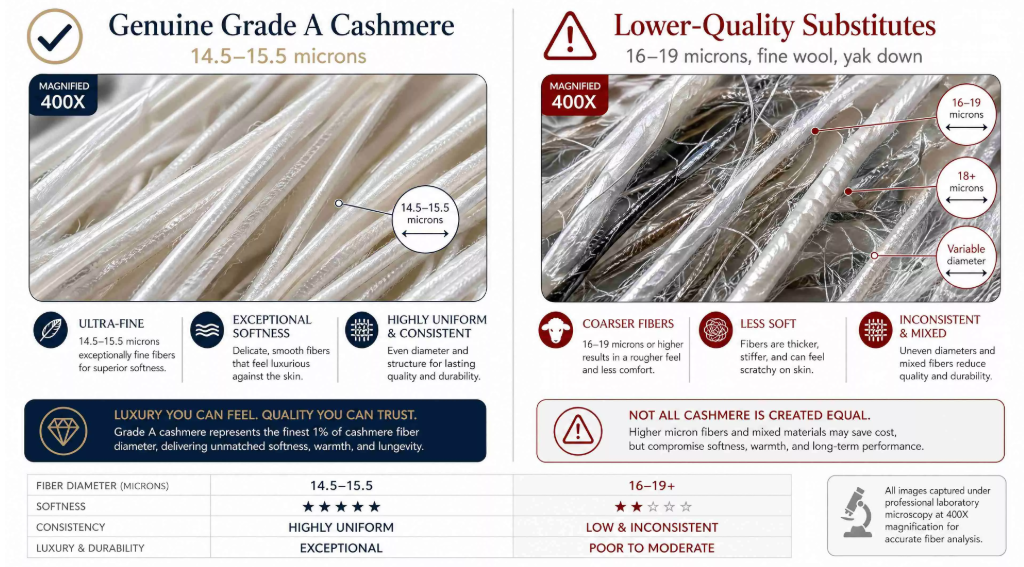
Fiber diameter, measured in microns (μm), is the primary determinant of softness and the most cited quality metric. Cashmere diameter ranges from approximately 13 microns at the finest extreme to 19 microns at the legal upper limit for the term "cashmere" in most markets.
The relationship between diameter and softness is not linear. It maps against the human tactile threshold. Fingertips detect surface irregularities at approximately 20–25 microns. Fibers below this threshold feel "invisible" to the skin, creating the sensation of smoothness. Cashmere at 14 microns sits far below the threshold. Cashmere at 19 microns brushes against it. A consumer can feel the difference between a 15-micron scarf and a 19-micron scarf, even if both are labeled "100% Cashmere."
Fiber diameter also affects the number of fibers per unit weight. A kilogram of 14-micron cashmere contains approximately 60% more individual fibers than a kilogram of 18-micron cashmere. This higher fiber count creates more air-trapping surfaces, which is why finer cashmere is warmer per gram, not just softer. For the full physics of warmth-to-weight ratios across fibers, see our fiber warmth comparison guide.
Metric 2: Fiber Length
Fiber length determines how securely individual fibers anchor into the yarn structure. Short fibers, known in the trade as "noil" or short-staple waste, have fewer points of contact with neighboring fibers. Under friction, they work loose, migrate to the fabric surface, and form pills.
Cashmere fiber length ranges from approximately 28mm at the commercial lower end to 42mm for premium fiber. The length difference between 30mm and 40mm may not sound dramatic, but in yarn engineering terms it represents a roughly 30% increase in fiber-to-fiber contact surface area. That additional contact translates directly into reduced pilling and longer garment life.
Fiber length is the metric most commonly sacrificed when manufacturers cut costs. Short-staple cashmere is significantly cheaper than long-staple, but the quality penalty is severe. A scarf made from short-staple cashmere will pill within weeks of wear. A scarf made from long-staple cashmere, properly cared for, will maintain its surface for years. Our Pilling Guide explains the physical mechanism in detail.
Metric 3: Dehaired Purity
Raw cashmere, as combed from the goat, is a mixture of fine undercoat (the valuable fiber) and coarse guard hair that must be removed through a mechanical process called dehairing. Dehaired purity is the percentage of fine cashmere fiber remaining after dehairing. A purity of 98% means 2% guard hair or other contaminants remain.
Guard hair is rough and stiff. Even 2-3% guard hair content is perceptible to the wearer, creating the occasional prickling sensation in an otherwise soft scarf. Premium cashmere targets 98.5% purity or higher. Commercial cashmere accepts 90–95%.
Purity is the metric most invisible to consumers and most exploited by cost-cutters. A scarf can have excellent diameter and length specifications but suffer from low purity, making it feel inconsistent against skin. No consumer-level test can measure purity. It requires laboratory analysis.

The 5-Tier Cashmere Classification System
The following classification synthesizes data from Chinese national standard GB/T 18132, Mongolian grading practices, and European textile research into a single framework. These are not official industry grades. They are a translation of raw measurement data into quality tiers that correspond to real-world product performance.
Tier 1: Ultra-Fine (Baby Cashmere)
| Fiber Diameter | 13.0–14.5 μm |
| Fiber Length | 34–40 mm |
| Purity | ≥ 99.0% |
| Global Share | < 0.5% of production |
| Source | First combing of kids under 12 months |
Baby cashmere is harvested from the first combing of young goats. The fiber is the finest and shortest of all cashmere grades. Its diameter falls below the threshold at which human skin can detect individual fibers, producing a sensation that is often described as weightless. The Alxa region of Inner Mongolia is the primary source, where winter temperatures below -30°C drive goats to produce an exceptionally fine undercoat for survival.
Baby cashmere represents less than half of one percent of global cashmere production. Its price reflects its rarity. Scarves made from Tier 1 cashmere are luxury goods by any definition, with raw material cost alone exceeding the total retail price of most cashmere scarves on the market.
Tier 2: Superfine
| Fiber Diameter | 14.5–15.5 μm |
| Fiber Length | 36–42 mm |
| Purity | ≥ 98.5% |
| Global Share | ~5% of production |
| Source | Select adult goats, cold-climate regions |
Superfine cashmere is the highest grade of adult cashmere routinely available in commercial quantities. It comes from goats raised in the coldest regions, where harsh winters stimulate the growth of a denser, finer undercoat. The longer fiber length at this tier (36–42mm) is a key differentiator: longer fibers produce stronger yarn with less pilling tendency than shorter fibers at the same diameter.
Tier 2 cashmere is the sweet spot for premium scarf manufacturing. It provides near-baby-cashmere softness with better durability and at roughly one-third to one-half the raw material cost. The supply is limited but accessible: approximately 5% of global cashmere production falls into this tier.
Tier 3: Fine (Standard Premium)
| Fiber Diameter | 15.5–16.5 μm |
| Fiber Length | 34–40 mm |
| Purity | ≥ 97.0% |
| Global Share | ~20% of production |
| Source | Adult goats, primary combing regions |
Tier 3 is the grade most commonly found in quality cashmere retail. The Chinese national standard GB/T 18132 classifies fiber in this range as first-grade cashmere. It is soft, warm, and suitable for all garment types. Most high-quality cashmere scarves sold at the $80–$200 retail price point use Tier 3 fiber.
The difference between Tier 3 and Tier 2 is not dramatic to the touch for most consumers. Under controlled conditions, trained testers can distinguish them. In normal wear, the practical difference is primarily durability: Tier 2's longer fibers produce less pilling over time.
Tier 4: Standard
| Fiber Diameter | 16.5–18.0 μm |
| Fiber Length | 32–38 mm |
| Purity | ≥ 95.0% |
| Global Share | ~40% of production |
| Source | Adult goats, mixed regions |
Tier 4 is the workhorse of the cashmere industry. It is the most widely produced grade and the baseline for what consumers typically encounter in mid-market cashmere products. At this diameter, the fiber approaches the tactile threshold. Some wearers will perceive a very slight texture. Most will still describe the scarf as "soft," but the sensation differs measurably from Tier 2 or 3.
Tier 4 cashmere's advantage is a balance of acceptable softness with better durability than finer grades. Coarser fibers resist breakage and abrasion more effectively. For scarves intended for heavy daily wear, Tier 4 can be a practical choice that outlasts a Tier 2 equivalent.
Tier 5: Commercial
| Fiber Diameter | 18.0–19.5 μm |
| Fiber Length | 28–34 mm |
| Purity | ≥ 90.0% |
| Global Share | ~35% of production |
| Source | Adult goats, warmer regions, later combings |
Tier 5 represents the lower boundary of what can legally be labeled as cashmere. At 19 microns, the fiber is at the FTC and Woolmark upper limit. It is noticeably coarser than higher tiers and the shorter fiber length (28–34mm) means higher pilling propensity. The lower purity threshold (≥90%) allows up to 10% guard hair or other contaminants.
Tier 5 cashmere is widely used in mass-market cashmere products and is frequently blended with merino wool or silk to improve hand feel. A scarf made from Tier 5 fiber that is properly labeled as "100% Cashmere" is legally compliant. Whether it meets consumer expectations at the price point is a separate question.
Why Origin Matters for Grade
Cashmere quality is not randomly distributed. It follows geography and climate.
Inner Mongolia (China): The dominant global producer at approximately 69% of world output. The Alxa region, in particular, produces the finest grades due to extreme winter temperatures that stimulate the growth of exceptionally fine undercoat. Chinese cashmere spans the full quality spectrum, from baby cashmere through commercial grade.
Mongolia: Produces approximately 20% of global cashmere. Mongolian fiber is generally coarser than Inner Mongolian fiber, averaging 16–19 microns, but is prized for its longer fiber length (36–40mm average) and brighter white color. Mongolian cashmere tends toward Tier 3 and 4 on this classification system, with less Tier 1 and 2 production than Inner Mongolia's premium regions.
Iran, Afghanistan, Central Asia: Smaller producers with fiber that is generally coarser and darker, typically falling into Tier 4 and 5. This cashmere is commonly used in blends where the fiber's natural brown or gray color is treated as a feature, eliminating the need for bleaching and dyeing.
A label that specifies "Inner Mongolian Cashmere" signals a higher probability of fine fiber than a label that reads only "Cashmere." It is a probabilistic signal, not a guarantee. Counterfeit origin claims exist, and the only verification is fiber testing. Our lab-grade authentication guide covers the methods that can verify fiber origin claims.

How to Read a Cashmere Quality Claim
When a supplier or brand makes a quality claim about cashmere, map it to these three questions:
- What is the fiber diameter, in microns? If the answer is a marketing term like "Grade A" or "Premium" without a micron number, the claim is not verifiable. A micron range tells you the actual fiber specification.
- What is the fiber length? If no length specification is provided, assume the shorter end of the range for the claimed diameter. Fiber length is the metric most often omitted from marketing materials because it is the one most often compromised.
- Where is the fiber from? Origin is not a quality grade, but it correlates with quality probability. Inner Mongolian fiber from a named region (Alxa, Ordos) is more likely to be fine-grade than generic Chinese cashmere.
If the supplier cannot answer these three questions with numbers, not adjectives, the cashmere they are selling is almost certainly Tier 5 commercial grade. There is nothing wrong with Tier 5 cashmere at a Tier 5 price point. The problem is Tier 5 cashmere sold with Tier 2 language and a Tier 2 markup.
Technical references: GB/T 18132 (Chinese National Cashmere Standard); Selvane 5-Tier Cashmere Classification Framework (2026); Textile Exchange Materials Market Report; ISO 17751-1:2023; Woolmark Company cashmere fiber definition.
Looking for verified cashmere scarf suppliers? Source scarves directly from Weave Essence.
Want to see more? Explore the online showroom.