Incoterms Guide for Knitwear Buyers | Knitted Scarves & Beanies

Incoterms Guide for Knitwear Buyers
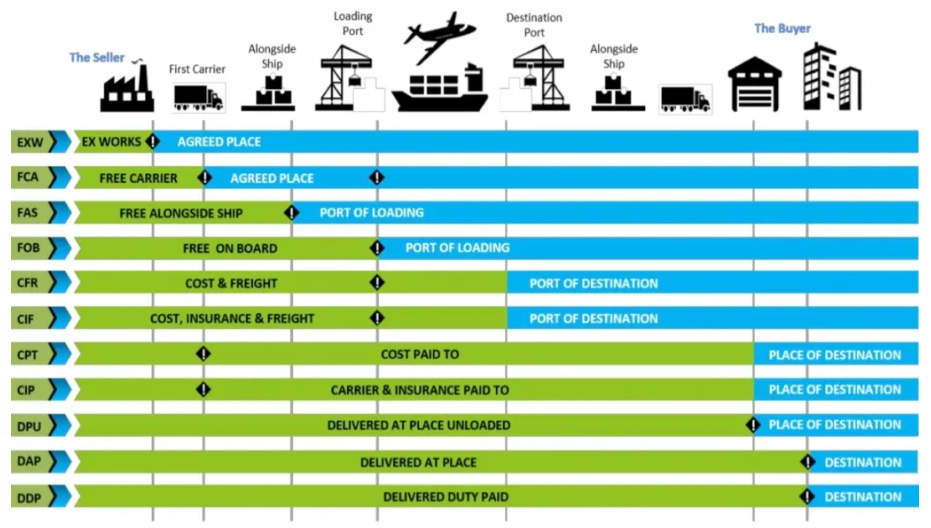
Incoterms (International Commercial Terms) define who pays for what, who bears risk, and where responsibility transfers between buyer and seller. Understanding Incoterms is essential for budgeting, risk management, and avoiding costly disputes.
This guide covers the most common Incoterms for knitted scarves and beanies — EXW, FOB, CIF, DDP — with cost allocation and risk transfer points. For a complete sourcing framework, see our Complete Sourcing Guide for Knitted Scarves & Beanies.
1. Why Incoterms Matter for Buyers
- Cost allocation: Know exactly what you are paying for
- Risk transfer: Know when you assume responsibility for the goods
- Insurance requirements: Know who needs to insure the shipment
- Customs clearance: Know who handles export and import documentation
- Dispute prevention: Clear terms prevent misunderstandings
For buyers: The Incoterm in your purchase order determines your total landed cost and risk exposure. Never leave it unspecified.
For cost analysis, see our Cost Breakdown Guide.
2. Incoterms Overview
The current version is Incoterms 2020. The most common terms for knitwear imports are EXW, FOB, CIF, and DDP.
Quick Reference Table
- EXW (Ex Works): Buyer handles everything — from factory pickup to import
- FOB (Free on Board): Seller delivers to port, loads on vessel — buyer handles ocean freight and import
- CFR/CNF (Cost and Freight): Seller pays for ocean freight — buyer handles import
- CIF (Cost, Insurance, Freight): Seller pays for ocean freight and minimum insurance — buyer handles import
- DDP (Delivered Duty Paid): Seller handles everything — delivered to buyer's door, duties paid
For shipping guidance, see our Sampling & Lead Time Guide.
3. EXW (Ex Works)
What it means: The seller makes the goods available at their factory or warehouse. The buyer is responsible for everything else — loading, export clearance, main carriage, insurance, import clearance, and final delivery.
Risk transfer point: When goods are made available at seller's premises.
Buyer responsibilities:
- Arrange and pay for loading at seller's factory
- Arrange and pay for export clearance
- Arrange and pay for all transportation
- Arrange and pay for insurance
- Arrange and pay for import clearance and duties
- Arrange final delivery
When to use EXW: You have a freight forwarder in China who handles everything. You want maximum control over shipping. You have experience with international logistics.
Warning: EXW places the most responsibility on the buyer. If you are not experienced with international shipping, this is not the best choice.
4. FOB (Free on Board)
What it means: The seller delivers the goods to the named port of shipment and loads them onto the vessel. The buyer bears all costs and risks from that point forward.
Risk transfer point: When goods are loaded onto the vessel at the port of shipment (e.g., FOB Ningbo, FOB Shanghai).
Seller responsibilities:
- Factory production and packing
- Inland transport to port
- Export clearance
- Loading onto vessel
Buyer responsibilities:
- Ocean freight
- Insurance
- Import clearance and duties
- Final delivery
When to use FOB: Most common for China exports. You want seller to handle export but you want control over ocean freight. You have a freight forwarder for the import side.
Standard for China scarf exports: FOB Ningbo, FOB Shanghai, or FOB Guangzhou.
5. CIF (Cost, Insurance, Freight)
What it means: The seller arranges and pays for ocean freight and minimum insurance to the named destination port. Risk transfers when goods are loaded on the vessel in China.
Risk transfer point: When goods are loaded onto the vessel at the port of shipment (same as FOB).
Seller responsibilities:
- Factory production and packing
- Inland transport to port
- Export clearance
- Loading onto vessel
- Ocean freight to destination port
- Minimum insurance (110% of CIF value)
Buyer responsibilities:
- Import clearance and duties
- Final delivery
- Additional insurance (if desired)
When to use CIF: You want seller to handle shipping. You are not experienced with ocean freight. You are buying smaller quantities (LCL).
Warning: Seller controls shipping. You cannot choose your own freight forwarder. Insurance is minimum coverage only.
6. DDP (Delivered Duty Paid)
What it means: The seller assumes all responsibility — delivering the goods to your named destination, including paying import duties and taxes.
Risk transfer point: When goods are made available at the named destination (e.g., your warehouse).
Seller responsibilities:
- Factory production and packing
- All transportation (China to your door)
- Export and import clearance
- Import duties and taxes
- Insurance
Buyer responsibilities: Unload goods at destination.
When to use DDP: You want a delivered price with no surprises. You do not want to handle logistics. You are buying small quantities.
Warning: DDP price is higher (seller includes all costs). Seller controls shipping — you cannot choose your own forwarder. Some sellers are not experienced with DDP.
For compliance guidance, see our Compliance Guide for Knitted Scarves & Beanies.
7. Cost Allocation by Incoterm
Example: Cashmere Scarf from China to EU (200 pcs, $32 FOB)
- EXW: $30 (factory price) + buyer arranges everything — most buyer responsibility
- FOB (Ningbo): $32 (includes inland freight + export clearance)
- CFR: $34 (FOB + ocean freight)
- CIF: $34.50 (CFR + minimum insurance)
- DDP: $45-50 (all costs including duties and VAT) — least buyer responsibility
Key insight: The price difference between FOB and DDP is typically 30-50% (ocean freight + insurance + duties + VAT).
For cost analysis, see our Cost Breakdown Guide.
8. Risk Transfer by Incoterm
- EXW: Risk transfers at seller's factory — buyer assumes risk immediately
- FOB: Risk transfers when goods loaded on vessel in China
- CIF: Risk transfers when goods loaded on vessel in China (same as FOB)
- DDP: Risk transfers at buyer's door — seller assumes all transit risk
Important: For FOB and CIF, risk transfers in China, even though seller arranges shipping for CIF. If goods are damaged during ocean transit, buyer must file claim with insurance.
9. Which Incoterm Should You Choose?
Decision Guide
- You have a freight forwarder in China: EXW or FOB
- You want control over shipping but need seller to handle export: FOB
- You are buying small quantities (LCL): CIF or DDP
- You want a delivered price with no surprises: DDP
- You are new to importing: CIF or DDP
- You are experienced and want lowest cost: EXW or FOB
Recommendation for First-Time Buyers
Start with CIF or DDP. You pay a bit more, but the seller handles logistics. Once you understand the process, switch to FOB to save costs.
10. Common Incoterm Mistakes
- No Incoterm specified: Disputes over who pays for what — always specify
- FOB without named port: "FOB China" is invalid — must name port (e.g., FOB Ningbo)
- Confusing CIF with DDP: CIF risk transfers in China; DDP risk transfers at your door — very different
- Assuming insurance on FOB: FOB has no insurance — buyer must arrange
- Not understanding duty responsibility: CIF and FOB do NOT include import duties — buyer pays
For compliance guidance, see our Compliance Guide for Knitted Scarves & Beanies.
11. Buyer's Incoterm Checklist
- Specify Incoterm in every purchase order (e.g., "FOB Ningbo, Incoterms 2020")
- Understand cost allocation for your chosen Incoterm
- Understand risk transfer point
- Arrange insurance if not included
- For DDP, confirm seller can handle import clearance in your country
- For FOB/EXW, have a freight forwarder ready
12. Questions to Ask Your Supplier
- What Incoterm do you recommend? Why?
- Can you provide pricing for EXW, FOB, CIF, and DDP?
- What is the named port for FOB?
- Do you have experience with DDP to my country?
- Can you provide a freight forwarder recommendation?
For supplier evaluation, see our 5 Red Flags When Evaluating a Knitting Factory.
13. Related Resources
- The Complete Sourcing Guide for Knitted Scarves & Beanies
- Cost Breakdown Guide
- Sampling & Lead Time Guide
- Compliance Guide for Knitted Scarves & Beanies
- MOQ Guide for Knitted Scarves & Beanies
- How to Write a Tech Pack
This guide is part of our Sourcing Tips series.