Knit Structures Guide: Rib, Jersey, Cable, and Jacquard

Knit Structures Guide: Rib, Jersey, Cable, and Jacquard
The stitch structure of a knitted scarf or beanie determines how it looks, feels, stretches, and wears. Different structures create different textures, elasticity, thickness, and cost.
This guide explains the most common knit structures for scarves and beanies — rib, jersey, cable, and jacquard — and helps you choose the right one for your product. For a complete technical framework, see our Knitting Basics: A Technical Guide for Buyers. For gauge guidance, see our Knitting Gauge (GG) Guide.
1. Rib Structure (1×1, 2×2, 4×4)
Rib is created by alternating knit and purl stitches in the same row. This creates vertical columns of stitches with natural elasticity.
Characteristics: High stretch and excellent recovery. Thick, textured surface. Does not curl at edges. Same appearance on both sides. Durable and shape-retaining.
Common rib ratios: 1×1 rib (fine, tight vertical lines, very high elasticity) for lightweight beanies and cuffs. 2×2 rib (medium, classic rib, high elasticity) for standard beanies and scarf ends — most common and best balance. 4×4 rib (bold, chunky ribs, moderate elasticity) for chunky scarves and oversized beanies.
Best applications: Beanie cuffs (2×2 rib — stays on head). Scarf ends (prevents curling). Full beanie (ribbed beanies). Infinity scarves (needs stretch to go over head).
Buyer considerations: Rib costs more than jersey because it requires more time on the machine. The 2×2 rib is the most common and offers the best balance of elasticity and cost.
For ribbing quality standards, see our Ultimate Guide to Quality for Knitted Scarves & Beanies.
2. Jersey (Plain Knit)
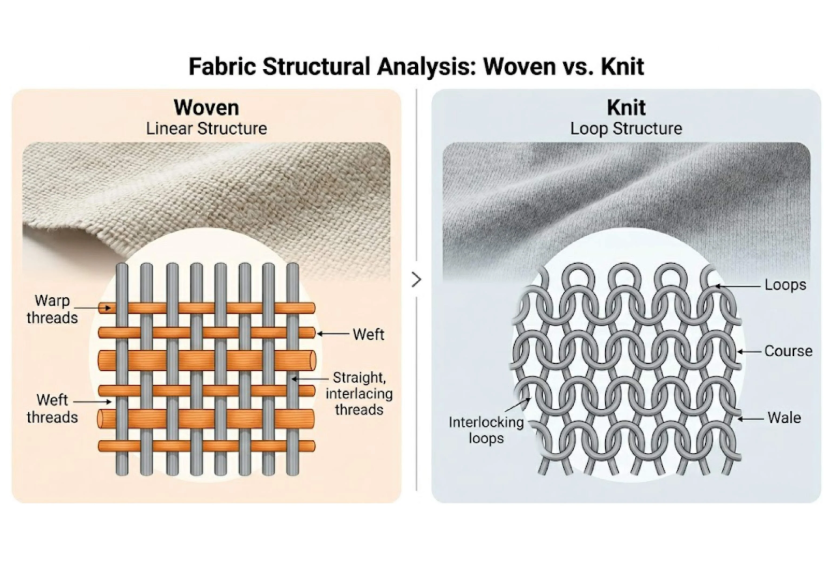
Jersey is the most basic knit structure. It is made by knitting every stitch on one side and purling every stitch on the other.
Characteristics: Lightweight and flexible. Smooth "V" pattern on front, horizontal bars on back. Tends to curl at edges (requires finishing). Less elastic than rib. Drapes well. Most economical structure.
Best applications: Lightweight summer scarves. Lining for woven scarves. Simple, casual beanies (with ribbed cuff). Children's accessories.
Buyer considerations: Jersey is the most economical knit structure. However, edges curl, so scarves need a hem or ribbed border. For beanies, jersey is usually combined with a ribbed cuff.
For edge finishing options, see our Ultimate Guide to Quality for Knitted Scarves & Beanies.
3. Cable Knit
Cable knit is created by crossing stitches over each other in repeating patterns, forming twisted, rope-like textures.
Characteristics: Thick, dense, highly textured. Very warm (traps air in twisted stitches). Limited stretch. Heavy and substantial. Traditional, heritage appearance. Most expensive structure due to slower production time.
Common cable patterns: Classic rope cable (traditional Aran). Honeycomb (diamond pattern). Zigzag (chevron effect). Horseshoe (linked loops).
Best applications: Chunky winter scarves (statement pieces). Traditional, heritage-style beanies. Luxury cashmere products. Gift items (high perceived value).
Buyer considerations: Cable knit is the most expensive structure due to slower production time. It requires skilled operators and specialized machine programming. For cost analysis, see our MOQ Guide for Knitted Scarves & Beanies.
4. Jacquard Knit
Jacquard is a technique where patterns are knitted directly into the fabric. Each needle is individually controlled, allowing complex designs.
Characteristics: Patterns are part of the fabric (not printed). Design visible on both sides (reversed on back). Durable — pattern will not wash off. Thicker than printed fabric. Higher setup cost.
Types of jacquard: Electronic jacquard (computer-programmed, fast setup) for complex patterns and repeat designs. Reversible jacquard (two different patterns front and back) for premium scarves and luxury positioning. Intarsia (separate yarns for each color block, no floats on back) for geometric designs, logos, multi-color.
Best applications: Branded scarves with logos. Geometric and floral patterns. Team scarves (sports clubs, universities). Premium holiday/seasonal designs.
Buyer considerations: Jacquard requires higher MOQ due to pattern setup costs (typically $100-300 per design). For MOQ guidance, see our MOQ Guide for Knitted Scarves & Beanies.
5. Structure Comparison Table
- Rib: High stretch, medium thickness, no curling, medium cost — best for beanies, cuffs, scarf ends
- Jersey: Low-medium stretch, thin, curls, low cost — best for lightweight scarves, linings
- Cable: Low stretch, thick, no curling, high cost — best for chunky winter scarves
- Jacquard: Low stretch, medium-thick, no curling, medium-high cost — best for patterned, branded scarves
For quality expectations by structure, see our Ultimate Guide to Quality for Knitted Scarves & Beanies.
6. How to Choose the Right Structure
For beanies: Standard beanie: 2×2 rib (best elasticity, stays on head). Chunky beanie: cable knit (bold texture, warm). Lightweight beanie: jersey with ribbed cuff (economical). Branded beanie: jacquard (logo knitted in).
For scarves: Winter scarf: 2×2 rib or cable (warm, substantial). Fashion scarf: jersey or jacquard (drape, pattern). Scarf ends: rib structure (prevents curling). Branded scarf: jacquard (logo or pattern).
7. Structure and Yarn Compatibility
Rib: 5-12gg, Nm 20/2 – Nm 60/2 — clear vertical lines. Jersey: 7-14gg, Nm 28/2 – Nm 80/2 — smooth surface. Cable: 3-7gg, Nm 6/1 – Nm 28/2 — clear cable definition. Jacquard: 7-12gg, Nm 28/2 – Nm 60/2 — pattern clarity.
For yarn count guidance, see our Yarn Count (Nm) Explained guide. For gauge guidance, see our Knitting Gauge (GG) Guide.
8. Common Structure Mistakes
- Using jersey for beanies without ribbed cuff — beanie will not stay on head; always add ribbed cuff.
- Choosing cable for lightweight product — cable is thick and heavy; not suitable for summer scarves.
- Specifying jacquard for low MOQ — pattern setup cost makes small orders expensive; consider printed fabric.
- Ignoring edge curling — jersey edges curl; specify hem or ribbed border.
For supplier evaluation, see our 5 Red Flags When Evaluating a Knitting Factory.
9. Buyer's Structure Checklist
Before sampling: Define desired appearance (smooth, textured, patterned, ribbed). Select structure based on product type and use case. Confirm factory has capability for chosen structure. For jacquard, prepare pattern file.
During sampling: Verify structure matches specification. Check edge finishing (curl or no curl). For rib, test elasticity and recovery. For cable, verify pattern clarity. For jacquard, check pattern registration.
For quality checks, see our Ultimate Guide to Quality for Knitted Scarves & Beanies.
10. Related Resources
- Knitting Basics: A Technical Guide for Buyers
- Knitting Gauge (GG) Guide
- Yarn Count (Nm) Explained
- Knitted vs Woven Scarves
- The Ultimate Guide to Quality for Knitted Scarves & Beanies
- MOQ Guide for Knitted Scarves & Beanies
This guide is part of our Knitting Basics series.