Fabric Defect Identification Guide | Knitted Scarves & Beanies

Fabric Defect Identification Guide for Knitted Scarves & Beanies
Knowing how to identify fabric defects is essential for buyers, quality control teams, and product developers. Early detection prevents defective products from reaching customers and helps you communicate effectively with suppliers.
This guide covers the most common defects in knitted scarves and beanies — what they look like, what causes them, and how to prevent them. For a complete quality framework, see our Ultimate Guide to Quality for Knitted Scarves & Beanies. For inspection standards, see our Dimensional Tolerance Guide.
1. Why Defect Identification Matters for Buyers
Understanding defects helps you communicate clearly with factories (use standard terms), catch problems early (before bulk production), distinguish between minor and major defects, make informed accept/reject decisions, and prevent the same defect from recurring.
For quality inspection standards, see our Ultimate Guide to Quality for Knitted Scarves & Beanies.
2. Defect Classification System
Critical defects: Safety hazard or regulatory violation. Examples: sharp objects, prohibited substances, incorrect fiber label. AQL: 0% (zero tolerance).
Major defects: Functional failure or strong aesthetic impact. Examples: hole, severe pilling, wrong dimensions (>5% deviation), broken seam. AQL: ≤2.5%.
Minor defects: Slight aesthetic issue, unlikely to affect satisfaction. Examples: small slub, slight tension variation, minor color variation. AQL: ≤4.0%.
For AQL standards, see our Ultimate Guide to Quality for Knitted Scarves & Beanies.
3. Knitting Defects
Dropped stitch: Vertical line or hole where a stitch was missed. Root cause: needle malfunction, yarn breakage. Prevention: regular machine maintenance, operator training, in-process inspection. Severity: major — reject.
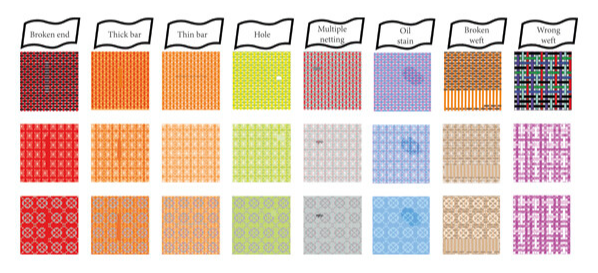
Oil stain: Yellow or brown spots on the fabric surface. Root cause: machine lubrication contamination, improper cleaning. Prevention: barrier shields on machines, regular cleaning schedule. Severity: major — reject.
Uneven tension: Wavy edges, irregular surface, visible stripe effect. Root cause: incorrect machine settings, uneven yarn tension, operator error. Prevention: first-piece approval, tension calibration, regular checks. Severity: major — reject.
Skipped stitch: Missing loop in pattern, visible gap in the knit structure. Root cause: needle or yarn issue, machine timing off. Prevention: needle inspection, machine maintenance, in-process checks. Severity: major — reject.
Yarn break: Broken yarn with visible repair knot or tuck mark. Root cause: weak yarn, tension too high, yarn defect. Prevention: yarn incoming inspection, tension adjustment. Severity: major — reject.
Slub: Short, thick place in yarn, visible as a raised area. Root cause: raw yarn defect (short thick slub) or matted fiber group. Prevention: yarn incoming inspection, electronic yarn clearer on winding. Severity: minor (if isolated) — accept with tolerance; major (if numerous).
For yarn quality guidance, see our Yarn Count (Nm) Explained guide.
4. Dyeing and Finishing Defects
Unlevel dyeing: Patchy, uneven color distribution across the fabric. Root cause: uneven liquor circulation, inadequate wetting-out, incorrect dyeing parameters. Prevention: proper wetting agent, dye liquor circulation check, operator training. Severity: major — reject.
Shade variation between lots: Different batches have noticeably different colors. Root cause: different dye recipe for same Pantone, different fiber lot. Prevention: spectrophotometer measurement, approved recipe system, head-to-head confirmation. Severity: major — reject.
Metamerism: Colors match under one light but not another (e.g., store vs. daylight). Root cause: different dye formulations used to match the same color. Prevention: spectrophotometer measurement under multiple illuminants (D65, A, TL84). Severity: major — reject for premium products.
Head/tail shade variation: First and last meters of fabric have different shade. Root cause: dye bath exhaustion over time. Prevention: continuous dye addition process, batch size limit. Severity: major — reject.
Pilling after finishing: Small balls of fiber on the fabric surface. Root cause: insufficient anti-pilling treatment, poor yarn quality, excessive raising. Prevention: pilling test at development stage, bio-polishing process, proper raising parameters. Severity: major (Grade ≤2) — reject.
Uneven raising: Areas of higher/lower nap density. Root cause: non-uniform tension across fabric width, wire card condition. Prevention: pre-raising tension check, card clothing maintenance. Severity: major — reject.
For color fastness issues, see our Color Fastness Guide.
5. Dimensional and Construction Defects
Length/width variation: Scarf length or width outside specified tolerance. Root cause: inconsistent knitting tension, improper finishing, no relaxation. Prevention: in-process dimensional checks, proper relaxation before measurement. Severity: major (if >5% deviation) — reject.
Bow and skew: Pattern lines curved (bow) or diagonal (skew). Root cause: uneven tension across fabric width, improper finishing. Prevention: stenter frame correction, tension monitoring. Severity: major — reject.
Edge curling: Fabric edges curl inward instead of lying flat. Root cause: jersey structure without edge finishing. Prevention: specify ribbed edge or hem for jersey products. Severity: minor (if expected) — accept; major (if specified flat).
Fringe inconsistency: Fringe ends are uneven length or loose. Root cause: hand trimming variation, poor knotting. Prevention: use automated trimming, knot quality check. Severity: minor (if ±1cm) — accept; major (if >±2cm) — reject.
For dimensional tolerances, see our Dimensional Tolerance Guide.
6. Defect Identification Flowchart
Inspect scarf/beanie
    ↓
Visible defect?
    ↓ YES
Is it a safety hazard? → YES → CRITICAL (0% tolerance)
    ↓ NO
Does it affect function or strongly affect appearance? → YES → MAJOR (AQL 2.5)
    ↓ NO
Slight cosmetic issue only? → YES → MINOR (AQL 4.0)
7. Defect Tolerance Guidelines
Dropped stitch: 0 per scarf/beanie — any dropped stitch = reject.
Oil stain: 0 visible stains — if removable, may accept.
Slub: ≤2 per scarf (length <2cm) — more than 2 = reject.
Length deviation: ±2 cm — standard tolerance.
Width deviation: ±1 cm — standard tolerance.
Pilling grade: ≥3 (ISO 12945-2) — Grade 2 or lower = reject.
Color variation (ΔE): <1.5 (standard), <1.0 (premium) — above limit = reject.
For pilling standards, see our Knitted Scarf Pilling Guide.
8. Buyer's Defect Inspection Checklist
Before production: Review defect examples with factory. Agree on defect classification and tolerance. Define AQL levels for major and minor defects. Approve first-piece sample.
During production: Conduct in-process inspection at 30% and 60% completion. Check for recurring defects. Measure dimensions periodically. Document any issues immediately.
Final inspection (pre-shipment): Random sampling per ISO 2859-1. Check all defect categories. Measure dimensions. Review test reports (pilling, color fastness). Make accept/reject decision based on AQL.
For inspection standards, see our Ultimate Guide to Quality for Knitted Scarves & Beanies.
9. Questions to Ask Your Factory
- What is your defect rate from incoming inspection?
- Do you have a defect classification system?
- How do you track and address recurring defects?
- Can you provide defect photos for reference?
- What is your rework process and acceptable rework rate?
For supplier evaluation, see our 5 Red Flags When Evaluating a Knitting Factory.
10. Related Resources
- The Ultimate Guide to Quality for Knitted Scarves & Beanies
- Knitted Scarf Pilling Guide
- Color Fastness Guide
- Dimensional Tolerance Guide
- Yarn Count (Nm) Explained
- Knitting Gauge (GG) Guide
- 5 Red Flags When Evaluating a Knitting Factory
This guide is part of our Quality Guide series.
Contact us to discuss your quality inspection requirements →