GOTS, GRS, RWS Guide | Sustainable Certifications for Knitted Scarves & Beanies

GOTS, GRS, RWS Guide: Sustainable Certifications for Knitted Scarves & Beanies
Sustainability certifications are no longer just marketing badges — they are requirements for many retailers and brands. Understanding GOTS, GRS, and RWS helps you meet buyer demands and verify supplier claims.
This guide explains each certification, requirements, chain of custody, and how to verify certificates. For compliance requirements, see our Compliance Guide for Knitted Scarves & Beanies. For OEKO-TEX guidance, see our OEKO-TEX Standard 100 Guide.
1. Certification Overview
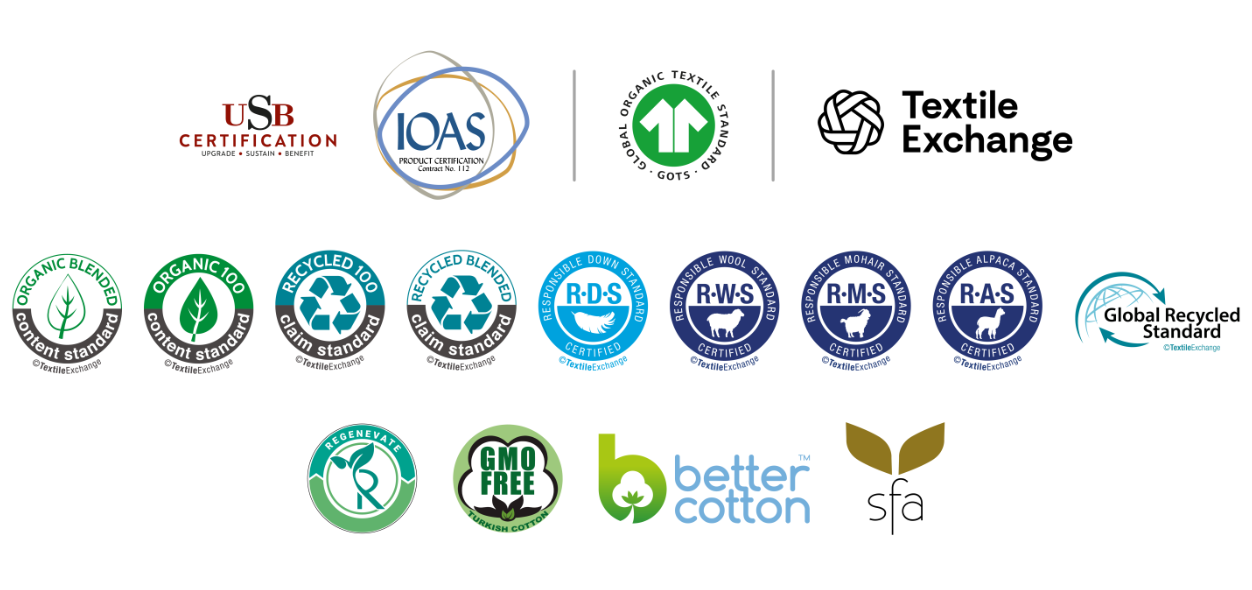
GOTS (Global Organic Textile Standard): Organic fibers + environmental processing + social compliance. Best for organic cotton, organic wool scarves & beanies. High demand in EU retailers and sustainable brands.
GRS (Global Recycled Standard): Recycled content + chain of custody + social/environmental requirements. Best for recycled polyester, recycled cotton scarves & beanies. Medium-high demand for brands with recycled claims.
RWS (Responsible Wool Standard): Animal welfare + land management + chain of custody. Best for wool and cashmere scarves & beanies. Medium-high demand in EU retailers and luxury brands.
2. GOTS (Global Organic Textile Standard)
GOTS is the world's leading processing standard for textiles made from certified organic fibers. It covers the entire supply chain — from fiber to finished product.
Fiber requirements: "Organic" label: ≥95% certified organic fibers. "Made with X% Organic Materials" label: ≥70% certified organic fibers. Organic certification must be USDA NOP, EU Organic, or equivalent.
Processing requirements (selected): Prohibited dye classes: azo dyes releasing carcinogenic amines, heavy metal-based dyes, chrome mordanting. Prohibited finishing chemicals: formaldehyde-releasing agents, PFAS/PFOA, nanoparticles. Wastewater treatment: licensed facility required; effluent standards specified. Workers' rights: ILO core labor standards (no child labor, no forced labor, freedom of association).
Chain of custody: Every stage — gin, spinning, knitting/weaving, dyeing, finishing, cutting/sewing — must hold a valid GOTS facility certificate.
How to verify GOTS certification: Search the public database at global-standard.org → GOTS Public Database. Enter the certificate number or facility name. Verify: certificate holder, facility name, product category, valid dates. Each processing stage must have its own certificate.
Red flags: Supplier shows only a logo, no certificate number. Certificate number not found in public database. Certificate holder name different from supplier. Product category does not include your product type.
For factory evaluation, see our 5 Red Flags When Evaluating a Knitting Factory.
3. GRS (Global Recycled Standard)
GRS certifies recycled content, chain of custody, and social/environmental requirements. It is the standard for recycled polyester (rPET) and recycled cotton.
Key requirements: Minimum 20% recycled content to use the GRS claim. Minimum 50% recycled content for "Recycled" label. Chain of custody at every processing stage. Social and environmental requirements for processing facilities.
Documentation required: Scope Certificate (SC) — facility-level certification, valid for 1 year. Transaction Certificate (TC) — batch-level document for each commercial transaction. Without TC, recycled content claims cannot be verified.
The rPET supply chain: Post-consumer PET bottles → recycling facility (flakes) → pelletizer (pellets) → fiber spinner → yarn → fabric → scarf. Each step requires a TC for the batch.
How to verify GRS certification: Search at textileexchange.org → Certified Businesses. Request Scope Certificate from supplier. Request Transaction Certificate for your specific batch. Verify TC covers your product and quantity.
For material guidance, see our Yarn Count (Nm) Explained guide.
4. RWS (Responsible Wool Standard)
RWS certifies wool from farms that practice animal welfare and sustainable land management. It covers wool and cashmere products.
Key requirements: Animal welfare: Five Freedoms, no mulesing, no dehorning (phased out). Land management: soil health, water quality, biodiversity. Chain of custody from farm to finished product. Social requirements for workers.
What RWS covers: Farm certification — animal welfare, land management, worker welfare. Chain of custody — transport, processing, manufacturing. Product certification — final product label claim.
RWS label tiers: "RWS Certified" — product contains 100% RWS-certified wool. "XX% RWS Certified" — blended with other fibers (non-RWS).
How to verify RWS certification: Search at textileexchange.org → Certified Businesses. Verify Scope Certificate for each supply chain stage. Request Transaction Certificate for your batch. Check that certification covers cashmere (if applicable).
RWS vs Cashmere-specific standards: RWS was originally for wool but now includes cashmere. Cashmere-specific standards: SFA (Sustainable Fibre Alliance), CCS (Cashmere and Camel Hair). For cashmere, RWS or SFA are both accepted by major buyers.
For quality standards, see our Ultimate Guide to Quality for Knitted Scarves & Beanies.
5. Certification Comparison
GOTS: Organic cotton, organic wool. Requires ≥70-95% organic. Environmental processing and social compliance. No animal welfare. Requires chain of custody and Transaction Certificate.
GRS: Recycled polyester, recycled cotton. Requires ≥20-50% recycled. Environmental processing and social compliance. No animal welfare. Requires chain of custody and Transaction Certificate.
RWS: Wool, cashmere. No organic requirement. Land management only. Animal welfare included. Requires chain of custody and Transaction Certificate.
6. Which Certification Do You Need?
By product type: Organic cotton scarf → GOTS. Recycled polyester scarf → GRS. Wool or cashmere scarf with animal welfare claim → RWS. Wool or cashmere without animal welfare claim → OEKO-TEX (chemical safety only).
By buyer requirement: EU retailers (Zalando, ASOS, H&M) → GOTS or GRS or RWS depending on fiber. US retailers (Nordstrom, REI) → often require OEKO-TEX minimum; GOTS/GRS/RWS for claims. Luxury brands → RWS for cashmere/wool, GOTS for organic cotton. Sustainable fashion brands → GOTS, GRS, or RWS depending on positioning.
For market requirements, see our Compliance Guide for Knitted Scarves & Beanies.
7. Certification Cost and Timeline
GOTS: Initial cost $3,000-8,000, timeline 3-6 months, annual renewal $1,500-3,000.
GRS: Initial cost $2,000-5,000, timeline 2-4 months, annual renewal $1,000-2,000.
RWS: Initial cost $2,000-5,000, timeline 2-4 months, annual renewal $1,000-2,000.
Note: These costs are typically borne by the factory but may affect pricing for certified products.
8. Buyer's Certification Checklist
Before quoting: Confirm which certification(s) your buyer requires. Ask supplier for Scope Certificate number. Verify certificate in public database. Confirm product category includes your product type.
During sampling: Request that samples use certified materials. Ask for certificate update if material changes.
Before bulk production: Verify certificate is still active (not expired). Request Transaction Certificate for your order. Confirm chain of custody documentation.
Upon shipment: Keep Transaction Certificate for compliance records. Include certification claim on packaging/labels as required.
9. Questions to Ask Your Supplier
- What certifications do you hold (GOTS, GRS, RWS)?
- Can you provide your Scope Certificate number?
- Does your certificate cover our fiber type and product category?
- Can you provide a Transaction Certificate for our order?
- What is your certified production capacity?
For supplier evaluation, see our 5 Red Flags When Evaluating a Knitting Factory.
10. Related Resources
- Compliance Guide for Knitted Scarves & Beanies
- OEKO-TEX Standard 100 Guide
- The Ultimate Guide to Quality for Knitted Scarves & Beanies
- The Complete Sourcing Guide for Knitted Scarves & Beanies
- 5 Red Flags When Evaluating a Knitting Factory
- REACH & CPSIA Guide
This guide is part of our Compliance Guide series.