Seam Strength Testing Guide for Knitted Scarves & Beanies

Seam Strength Testing Guide for Knitted Scarves & Beanies
Seam failure is one of the most common quality complaints for knitted accessories. A scarf that unravels at the edge. A beanie where the cuff separates from the body. These failures are preventable with proper seam construction and testing.
This guide covers seam strength testing methods, acceptance criteria, common failures, and how to specify seam requirements in your tech pack. For a complete quality framework, see our Ultimate Guide to Quality for Knitted Scarves & Beanies.
1. Why Seam Strength Matters for Buyers
- Consumer safety: Seam failure can create choking hazards (small parts)
- Durability: Weak seams mean shorter product life
- Brand reputation: Seam failure is perceived as poor quality
- Compliance: Some markets require minimum seam strength for children's products
For brands: A seam that fails after normal use generates returns, negative reviews, and lost customers.
For manufacturers: Clear seam specifications prevent disputes over what is acceptable.
For quality standards, see our Ultimate Guide to Quality for Knitted Scarves & Beanies.
2. Types of Seams in Knitted Products
Common Seam Types for Scarves & Beanies
- Overlock seam (3-thread or 5-thread): Most common for knitted accessories. 5-thread overlock is stronger and more secure.
- Linking (loop-to-loop): Used for fully fashioned knitwear. Invisible seam, premium quality.
- Flat seam (mock safety stitch): Flat, comfortable against skin. Used for lightweight knits.
- Ribbed edge (self-finish): No seam — edge is knitted as part of the fabric. Strongest option.
- Attached components: Pompoms, tassels, buttons attached to scarves or beanies.
For edge finishing guidance, see our Ultimate Guide to Quality for Knitted Scarves & Beanies.
3. Seam Strength Test Methods
Standard Test Methods
- ASTM D1683 (US): Standard test method for seam strength in woven fabrics — also used for knits
- ISO 13935-2 (International): Seam tensile properties — sewn seams
- EN 16732 (Europe): Seam strength for textile products
How the Test Works
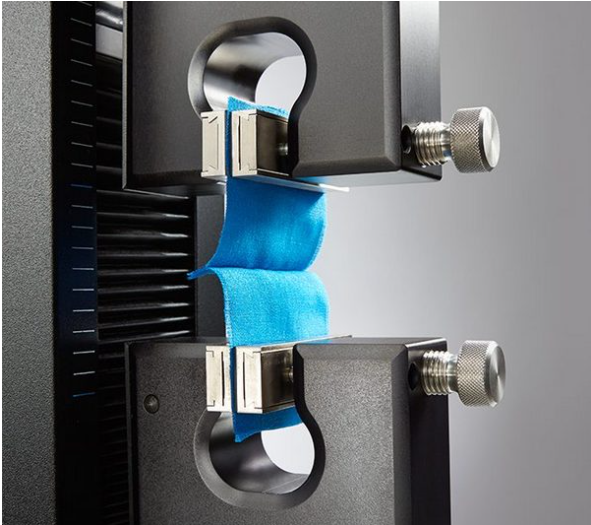
- A fabric sample with a seam is placed in a tensile testing machine
- The machine pulls the seam apart at constant speed (typically 200mm/min)
- The force required to break the seam is recorded in Newtons (N) or pounds (lbf)
- Failure can occur as seam rupture, yarn break, or fabric tear
Acceptance Criteria by Product Type
- Adult scarves (overlock seam): ≥50N (11.2 lbf)
- Adult beanies (overlock seam): ≥40N (9.0 lbf)
- Children's scarves (overlock seam): ≥70N (15.7 lbf)
- Attached pompoms (pull test): ≥30N (6.7 lbf) without detachment
- Attached tassels (pull test): ≥40N (9.0 lbf) without detachment
- Linking seam (fully fashioned): ≥60N (13.5 lbf)
For children's product compliance, see our REACH & CPSIA Guide.
4. Common Seam Failures and Root Causes
Seam Rupture (Seam opens)
- Visual: The seam pulls apart, threads break
- Root cause: Insufficient thread tension, incorrect stitch density, poor thread quality
- Prevention: Calibrate sewing machines, use quality thread, specify minimum stitch density
Yarn Break Adjacent to Seam
- Visual: Fabric tears next to the seam, seam remains intact
- Root cause: Weak fabric, needle damage, incorrect needle size
- Prevention: Use appropriate needle size (ballpoint for knits), test fabric strength
Seam Slippage (Seam grin)
- Visual: Seam opens but threads remain intact, creating a gap
- Root cause: Low stitch density, loose thread tension, fabric slippage
- Prevention: Increase stitch density, adjust thread tension, use anti-slip thread
Pompom/Tassel Detachment
- Visual: Attached component separates from product
- Root cause: Weak attachment stitching, poor knotting, incorrect attachment method
- Prevention: Specify minimum pull force, reinforce attachment points
For defect identification, see our Fabric Defect Identification Guide.
5. How to Specify Seam Requirements in Your Tech Pack
Complete Seam Specification Example
SEAM SPECIFICATION
- Seam type: 5-thread overlock
- Stitch density: 8-10 stitches per cm (20-25 per inch)
- Thread type: Polyester core-spun, Tex 30
- Needle type: Ballpoint size 75/11
- Seam allowance: 8mm ±1mm
- Thread tension: Balanced (no looping on either side)
- Pull test requirement: ≥50N (ASTM D1683)
Attached Component Specification
POMPOM ATTACHMENT SPECIFICATION
- Attachment method: Hand-knotted through fabric
- Knot type: Double overhand
- Pull test: ≥30N without detachment (ASTM D1683)
- Inspection: Every pompom tested or random sample per batch
For tech pack guidance, see our How to Write a Tech Pack.
6. Visual Seam Inspection Checklist
Before Production
- Approve seam sample (first-piece approval)
- Verify stitch density matches specification
- Check thread tension (no looping or puckering)
- Confirm needle type (ballpoint for knits)
During Production
- Inspect seams every 50-100 pieces
- Check for skipped stitches
- Verify seam allowance consistency
- Test pull force on random samples
Final Inspection
- Inspect all seams on finished products
- Pull test attached components (pompoms, tassels, labels)
- Check seam appearance (no puckering, no loose threads)
For inspection standards, see our Ultimate Guide to Quality for Knitted Scarves & Beanies.
7. Thread and Needle Selection
Thread Types
- Polyester core-spun: Strong, elastic, good for knits — recommended
- Cotton: Natural, but weaker — not recommended for stretch fabrics
- Nylon: Very strong, good for high-stress areas
- Silk: Luxury, but lower strength — use for decorative seams only
Needle Selection for Knits
- Ballpoint (style 2631): Rounded tip pushes between fibers instead of cutting — essential for knits
- Size 75/11: Standard for medium-weight knits (most scarves and beanies)
- Size 65/9: For lightweight, fine-gauge knits
- Size 80/12: For heavy, chunky knits
Warning: Using a sharp needle on knits cuts fibers, leading to yarn breakage and weak seams.
8. Seam Strength for Different Materials
- Cashmere: Delicate — use ballpoint needle, moderate tension, reinforce high-stress areas
- Wool: Good strength — standard seam construction works well
- Cotton: Good strength — standard seam construction works well
- Silk: Delicate — use fine thread, ballpoint needle, lower tension
- Recycled polyester: Good strength — standard seam construction works well
- Acrylic: Moderate strength — avoid excessive tension, use ballpoint needle
For material guidance, see our Sustainable Materials Guide.
9. Buyer's Seam Strength Checklist
- Specify seam type and stitch density in tech pack
- Request seam strength test reports (ASTM D1683 or ISO 13935-2)
- Approve seam sample before bulk production
- For attached components, specify minimum pull force
- Inspect seams during production and final inspection
- For children's products, ensure seam strength meets safety requirements
10. Questions to Ask Your Supplier
- What seam type do you use for this product?
- What is your standard stitch density (stitches per cm)?
- Do you perform seam strength testing? Can you provide test reports?
- What thread type do you use?
- Do you use ballpoint needles for knitted fabrics?
- How do you attach pompoms or tassels? What is the pull force?
For supplier evaluation, see our 5 Red Flags When Evaluating a Knitting Factory.
11. Related Resources
- The Ultimate Guide to Quality for Knitted Scarves & Beanies
- Fabric Defect Identification Guide
- Dimensional Tolerance Guide
- How to Write a Tech Pack
- Sampling & Lead Time Guide
- Compliance Guide for Knitted Scarves & Beanies
- REACH & CPSIA Guide
This guide is part of our Quality Guide series.