Spirality & Twisting Guide for Knitted Scarves & Beanies

Spirality & Twisting Guide for Knitted Scarves & Beanies
Spirality (also called twisting or skew) is a common but often overlooked defect in knitted fabrics. A scarf that twists when laid flat. A beanie where the seams spiral around the head. These defects make products look cheap and unprofessional — even when the material quality is excellent.
This guide explains what causes spirality, how to measure it, acceptance criteria, and how to prevent it. For a complete quality framework, see our Ultimate Guide to Quality for Knitted Scarves & Beanies.
1. What Is Spirality?
Spirality is the tendency of knitted fabric to twist or skew from its intended shape. In simple terms: a scarf that doesn't lie flat. A beanie where the side seam curves instead of running straight.
Visual appearance:
- Scarf edges are not parallel when laid flat
- Stripes or patterns appear diagonal instead of horizontal
- Side seams on beanies spiral around the head
- Fabric twists after washing
Why it matters: Spirality makes products look defective. Consumers perceive twisted products as poor quality, even if the material and construction are otherwise excellent.
For quality standards, see our Ultimate Guide to Quality for Knitted Scarves & Beanies.
2. What Causes Spirality?
Yarn-Related Causes
- Yarn twist direction: Single-ply yarns have inherent torque that causes fabric to twist
- Yarn twist level: Higher twist = higher torque = more spirality
- Unbalanced ply twist: Singles twist and ply twist should be opposite to balance torque
- Yarn relaxation: Yarn may untwist or over-twist during processing
Knitting-Related Causes
- Machine settings: Incorrect tension or feed settings
- Needle alignment: Misaligned needles produce uneven loops
- Yarn feed angle: Feed angle affects loop formation
- Machine speed: Very high speeds can increase torque
Finishing-Related Causes
- Uneven drying: Differential shrinkage across fabric width
- Stenter frame misalignment: Fabric not straightened during finishing
- Heat setting parameters: Incorrect temperature or time
- Wet processing: Agitation can increase spirality
For yarn guidance, see our Yarn Count (Nm) Explained guide.
3. How Spirality Is Measured
Test Methods
- AATCC 179 (US): Standard test method for skewness (spirality) in knitted fabrics
- ISO 16322 (International): Determination of spirality after laundering
- GB/T 23319 (China): Spirality test method
How the Test Works
- A fabric sample is marked with a reference line
- The sample is washed and dried according to specified conditions
- The deviation from the reference line is measured
- Result is expressed as a percentage or degrees of twist
Acceptance Criteria
- Standard commercial: ≤5% spirality
- Premium: ≤3% spirality
- Entry-level: ≤8% spirality
- Striped/patterned fabrics: ≤3% (patterns make spirality more visible)
For testing standards, see our Ultimate Guide to Quality for Knitted Scarves & Beanies.
4. Spirality by Fabric Type
Single Jersey (Plain Knit)
- Risk level: Highest — single jersey is most prone to spirality
- Typical spirality: 5-10% without treatment
- Prevention: Balanced twist yarn, heat setting, cross-tucking
1×1 Rib
- Risk level: Low — rib structures are more stable
- Typical spirality: 2-5%
- Prevention: Balanced twist yarn, proper finishing
2×2 Rib
- Risk level: Very low — most stable knit structure
- Typical spirality: 1-3%
- Prevention: Standard finishing usually sufficient
Interlock
- Risk level: Low — double-knit structure is stable
- Typical spirality: 2-4%
- Prevention: Balanced twist yarn
For knit structure guidance, see our Knit Structures Guide.
5. How to Prevent Spirality
Yarn Selection
- Use two-ply yarns: Two-ply yarns have lower torque than single-ply
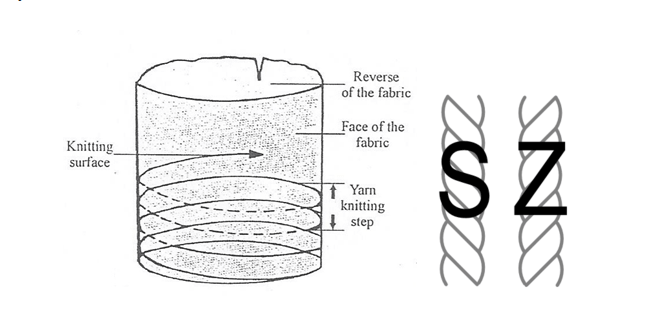
- Specify balanced twist: Singles twist S, ply twist Z (or opposite)
- Lower twist level: Lower twist = lower torque = less spirality (but softer hand feel)
- Avoid high-twist singles: High-twist singles have high torque
Knitting Parameters
- Use cross-tuck patterns: Cross-tucking locks loops and reduces spirality
- Optimize yarn feed tension: Consistent tension reduces torque
- Regular machine maintenance: Properly aligned needles and feeders
- Consider circular vs flat knit: Circular knit has more spirality than flat knit
Finishing Treatments
- Heat setting: Thermal stabilization reduces torque (essential for synthetics)
- Stenter frame straightening: Mechanical straightening during finishing
- Steaming/relaxation: Allows fabric to relax before final setting
- Overfeeding: Slight overfeed during finishing can reduce spirality
For finishing guidance, see our Ultimate Guide to Quality for Knitted Scarves & Beanies.
6. How to Specify Spirality Requirements
Complete Spirality Specification Example
SPIRALITY SPECIFICATION
- Maximum spirality: ≤5% (standard), ≤3% (premium)
- Test method: AATCC 179
- Measurement: After 3 wash cycles
- Sample size: 5 pieces per batch, average reported
- Patterned fabrics: ≤3% (patterns make spirality more visible)
Questions to Ask Your Supplier
- Do you test for spirality? What method do you use?
- What is your typical spirality for this product?
- Do you use two-ply or single-ply yarn?
- Do you heat set after finishing?
- Can you provide spirality test reports?
For supplier evaluation, see our 5 Red Flags When Evaluating a Knitting Factory.
7. Spirality vs Yarn Twist
Understanding the relationship between yarn twist and spirality is essential for buyers.
Single-Ply Yarns
- Torque: High — significant spirality
- Hand feel: Soft, airy
- Cost: Lower
- Spirality risk: High (8-15%)
Two-Ply Yarns
- Torque: Low (balanced)
- Hand feel: Slightly firmer
- Cost: Higher (+20-30%)
- Spirality risk: Low (2-5%)
Recommendation: For premium products where appearance matters, specify two-ply yarns.
For yarn count guidance, see our Yarn Count (Nm) Explained guide.
8. Spirality in Finished Products
Visual Inspection Checklist
- Lay scarf flat on a table — edges should be parallel
- Check stripes or patterns — should be horizontal, not diagonal
- Fold scarf lengthwise — edges should align
- For beanies, check side seam — should run straight vertically
- After washing, re-check — spirality may increase after laundering
Accept/Reject Criteria
- Accept: ≤5% spirality, not visible to casual inspection
- Reject: >8% spirality, visibly twisted, patterns clearly diagonal
- Negotiate: 5-8% spirality — depends on product type and price point
9. Buyer's Spirality Checklist
- Specify maximum spirality in tech pack
- Request test method (AATCC 179 or ISO 16322)
- Test after washing — spirality often increases with laundering
- For striped or patterned fabrics, specify tighter tolerance (≤3%)
- For single-ply yarns, expect higher spirality — plan accordingly
- Inspect visually on finished products
10. Related Resources
- The Ultimate Guide to Quality for Knitted Scarves & Beanies
- Yarn Count (Nm) Explained
- Knit Structures Guide
- Dimensional Tolerance Guide
- Fabric Defect Identification Guide
- Sampling & Lead Time Guide
- How to Write a Tech Pack
This guide is part of our Quality Guide series.