Fabric Defect Identification Guide for Knitted Scarves & Beanies

Fabric Defect Identification Guide for Knitted Scarves & Beanies
A hole in the middle of a scarf. A dropped stitch that unravels after the first wear. An oil stain that wasn't caught before packing. These defects are preventable — but only if you know what to look for and when to look.
This guide covers the most common fabric defects found in knitted scarves and beanies, how to identify them, what causes them, and how to prevent them. It also includes an inspection checklist and AQL (Acceptable Quality Limit) standards for knitwear.
1. Why Defect Identification Matters
For buyers, the ability to identify defects means:
- Fewer returns: Catching defects before shipment reduces customer complaints
- Stronger negotiation: You know exactly what to reject and why
- Better supplier relationships: Clear, specific feedback helps factories improve
For suppliers, systematic defect identification reduces claim rates and improves customer satisfaction. Most defects are caught during three inspection points: in-process (during knitting), final inspection (before packing), and third-party inspection (by buyer or agency).
2. Common Defects in Knitted Scarves & Beanies
2.1 Holes & Broken Yarns
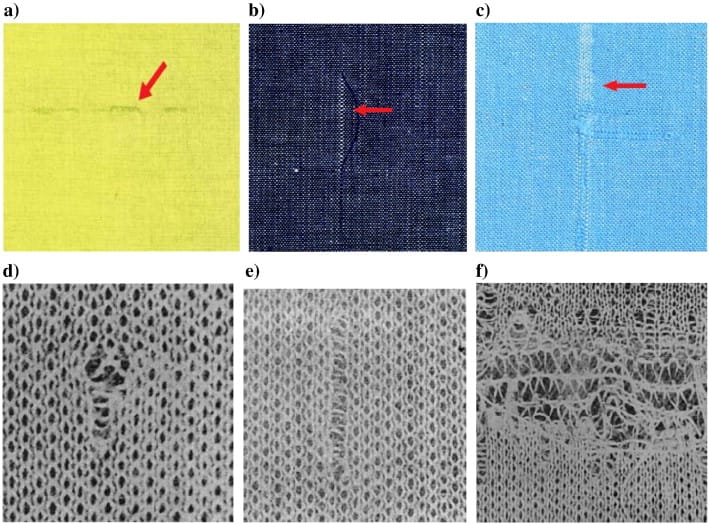
What to look for: Open spaces where yarn is missing or broken. Holes can be small (pin-sized) or large. They may appear as a single missing loop or a run that has laddered down several rows.
Causes: Damaged needles, yarn knots pulled into the machine, foreign objects on the machine bed, weak yarn spots.
Acceptance: Any hole is typically a major defect and grounds for rejection.
2.2 Dropped Stitches (Ladders/Runs)
What to look for: A vertical line where stitches have unraveled, creating a "ladder" effect. The fabric may have a visible line or gap.
Causes: Needle malfunction, yarn break during knitting, improper machine settings, operator error.
Acceptance: Any dropped stitch is a major defect unless repaired. Some minor dropped stitches can be repaired by hand, but the repair must be invisible.
2.3 Oil Stains & Dirt Marks
What to look for: Dark spots or streaks on the fabric. Oil stains are typically brown or black. Dirt marks may be gray or dark.
Causes: Machine oil leakage, dirty rollers, dirty work surfaces, poor handling during production.
Acceptance: Small, removable stains may be acceptable if they can be cleaned. Permanent or large stains are rejectable.
2.4 Uneven Dyeing / Shading
What to look for: Color variation across the scarf. This can be side-to-side (left darker than right), end-to-end (one end darker), or center-to-edge (center darker).
Causes: Uneven dye penetration, inconsistent temperature during dyeing, poor fabric preparation, different yarn lots.
Acceptance: Minor shading may be acceptable for lower-priced goods. Obvious shading visible from 1 meter is a major defect.
2.5 Spirality (Twisting)
What to look for: The scarf twists or spirals when laid flat. The edges do not lie straight. When hung, the scarf rotates.
Causes: Yarn torque (twist liveliness), improper relaxation, unbalanced knit structure.
Acceptance: Up to 5% twist may be acceptable. More than 5% is typically rejectable. (See the Spirality & Twisting Guide for details.)
2.6 Uneven Stitches / Tension Problems
What to look for: Some stitches are loose, others tight. The fabric surface looks uneven or wavy. In severe cases, there are visible "stripes" of loose and tight stitches.
Causes: Inconsistent yarn tension, faulty take-down mechanism, worn needles, yarn thickness variation.
Acceptance: Minor variation is normal in knitwear. Obvious unevenness visible from normal viewing distance is a defect.
2.7 Yarn Thickness Variation (Slubs)
What to look for: Thick and thin spots in the yarn itself, visible as bumps or thin sections in the fabric.
Causes: Poor quality yarn, inconsistent spinning, neps in raw fiber.
Acceptance: Some slubs are intentional in certain styles (slub yarns). Unintentional slubs are defects if they affect appearance or hand feel.
2.8 Pilling (Excessive)
What to look for: Small balls of tangled fiber on the fabric surface. Some pilling is normal; excessive pilling after minimal wear is a defect.
Causes: Short fiber length, low twist yarn, loose knit structure, lack of anti-pilling finish.
Acceptance: Depends on grade. Pilling grade 3-4 (ISO/ASTM scale) is typically acceptable. Grade 2 or lower is rejectable. (See the Pilling Guide for details.)
2.9 Needle Lines
What to look for: Vertical lines in the fabric caused by individual needles knitting differently. These may be tighter, looser, or different in appearance.
Causes: Worn or damaged needles, needles of different sizes, incorrect needle alignment.
Acceptance: Faint needle lines are common and often acceptable. Obvious lines visible from 1 meter are a defect.
2.10 Seam Defects (for sewn beanies or scarves)
What to look for: Open seams, skipped stitches, broken threads, puckering, or misaligned edges.
Causes: Poor sewing machine settings, dull needles, incorrect thread tension, operator error.
Acceptance: Any open seam or skipped stitch is a major defect. Minor puckering may be acceptable depending on severity.
3. Defect Severity Classification
For AQL (Acceptable Quality Limit) inspection, defects are typically classified into three levels:
| Severity | Definition | Examples | Action |
|---|---|---|---|
| Critical | Safety risk or legal violation | Sharp objects in product, prohibited chemicals | 0% tolerance — full rejection |
| Major | Will affect usability or durability | Hole, dropped stitch, open seam, large stain | Reject or require rework |
| Minor | Aesthetic issue,不影响基本功能 | Slight shading, faint needle line, small removable stain | Accept if within AQL limit |
4. AQL Standards for Knitted Accessories
AQL (Acceptable Quality Limit) defines the maximum number of defective units allowed in a sample. The most common standard for scarves and beanies is AQL 2.5 for major defects, AQL 4.0 for minor defects.
Sample AQL Table (Inspection Level II, Normal)
| Lot Size | Sample Size | Major Defects (AQL 2.5) | Minor Defects (AQL 4.0) |
|---|---|---|---|
| 281-500 | 50 | 3 accept / 4 reject | 5 accept / 6 reject |
| 501-1200 | 80 | 5 accept / 6 reject | 7 accept / 8 reject |
| 1201-3200 | 125 | 7 accept / 8 reject | 10 accept / 11 reject |
| 3201-10000 | 200 | 10 accept / 11 reject | 14 accept / 15 reject |
Interpretation: For a lot of 1000 scarves, you inspect 80 pieces. If you find 5 major defects, you accept. If you find 6 or more major defects, you reject the entire lot.
5. Inspection Points & Timing
5.1 In-Process Inspection (During Production)
Check early to catch problems before mass production:
- First 10-20 pieces of each machine/operator
- Check dimensions, stitch quality, and basic appearance
- Immediately stop production if major defects found
5.2 Final Random Inspection (Before Packing)
The standard AQL inspection after production is complete:
- Randomly select samples from finished goods
- Check all quality attributes (dimensions, defects, color, hand feel)
- Use AQL table to accept or reject
5.3 Pre-Shipment Inspection (PSI)
Typically performed by a third-party inspection company (SGS, Bureau Veritas, TÜV, Intertek):
- Inspector visits factory after 100% production is complete
- 80% or more must be packed for inspection to proceed
- Report issued within 24-48 hours
6. Buyer's Checklist: Inspection Requirements
- ✓ What AQL level do you require (e.g., AQL 2.5 major / 4.0 minor)?
- ✓ Do you require third-party pre-shipment inspection?
- ✓ Can you provide defect photos and an inspection report for each shipment?
- ✓ What is your process for rework and re-inspection after rejection?
- ✓ Who bears the cost of rework and re-inspection?
7. Defect Prevention Tips for Buyers
- Specify AQL levels in your purchase order — don't assume the supplier knows your standard
- Require defect photos with each inspection report
- Visit the factory or hire a local inspector for critical orders
- Build defect allowances into your pricing — no production is perfect
- Give clear, written defect definitions with photos before production starts
8. Related Guides from Weave Essence
This guide is part of the Quality Guide (L1) series. It provides in-depth coverage of fabric defect identification for knitted scarves and beanies (L2 depth).
Need help with quality inspection for your order? Contact our team →