Seam Strength Testing Guide for Knitted Scarves & Beanies

Seam Strength Testing Guide for Knitted Scarves & Beanies
A beanie that rips at the seam the first time it's pulled on. A scarf that comes apart at the join after light use. Seam failure is one of the most frustrating quality issues for end users — and one of the most preventable.
This guide covers seam strength testing for knitted scarves and beanies, including seam slippage, seam rupture, tensile testing methods (ASTM D1683, ISO 13935), and acceptable standards for different product types.
1. What is Seam Strength?
Seam strength is the force required to break or significantly damage a seam. For knitted accessories like scarves and beanies, seam strength determines how well the product holds up under normal use — pulling, stretching, washing, and wearing.
Two types of seam failure are measured:
- Seam rupture (yarn break): The seam thread or fabric yarn breaks under tension.
- Seam slippage (seam opening): The seam opens without thread or yarn breaking — the fabric slips out of the seam.
For knitwear, seam slippage is more common because knitted fabrics are more elastic than woven fabrics. The seam may stretch open before the thread actually breaks.
2. Key Test Methods
2.1 ASTM D1683
Standard Test Method for Failure in Sewn Seams of Woven Apparel Fabrics (commonly adapted for knitwear)
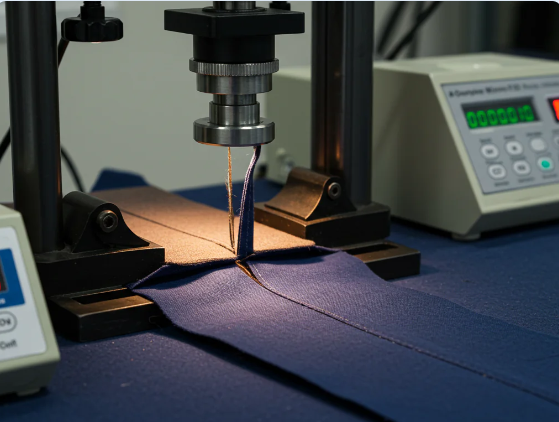
The specimen is clamped on both sides of the seam and pulled in a tensile testing machine until failure. The force at failure is recorded in Newtons (N) or pounds-force (lbf).
2.2 ISO 13935-2
Textiles — Seam tensile properties of fabrics and made-up textile articles — Part 2: Determination of maximum force to seam rupture using the grab method
Similar to ASTM D1683 but with different specimen dimensions and clamping methods. Results are recorded in Newtons (N).
2.3 ASTM D1683 / D434 (Seam Slippage)
Measures the force at which a seam opens to a specified gap (typically 3mm or 6mm). This is critical for loose-fitting scarves and beanies where seams are under constant light tension.
Comparison of Methods
| Method | Typical Specimen Size | Clamp Type | Measurement | Common For |
|---|---|---|---|---|
| ASTM D1683 | 100mm × 150mm | Grab (25mm width) | Force at seam failure | US market |
| ISO 13935-2 | 50mm × 200mm | Grab (25mm width) | Maximum force to rupture | EU & international |
| ASTM D434 | 100mm × 350mm | Strip (full width) | Force at 3mm or 6mm opening | Seam slippage only |
3. Acceptable Seam Strength Standards
Acceptable seam strength varies by product type, fabric weight, and buyer requirements. Below are typical minimum standards for knitted scarves and beanies.
3.1 By Product Type
| Product | Minimum Force (N) | Minimum Force (lbf) | Notes |
|---|---|---|---|
| Lightweight scarf (under 200gsm) | 80-100 N | 18-22 lbf | Delicate yarns may have lower strength |
| Midweight scarf (200-350gsm) | 100-150 N | 22-34 lbf | Standard commercial quality |
| Heavyweight scarf (over 350gsm) | 150-200 N | 34-45 lbf | Chunky knits, blanket scarves |
| Beanie (all weights) | 100-150 N | 22-34 lbf | Higher requirement due to stretch during wear |
3.2 By Fiber Type
| Fiber | Typical Seam Strength | Risk Factors |
|---|---|---|
| 100% Cotton | 120-180 N | Moderate — strong |
| 100% Wool | 100-150 N | Moderate — can be weak if low twist |
| 100% Acrylic | 80-120 N | Lower — acrylic has lower tensile strength |
| Cashmere / Merino | 80-120 N | Lower — fine fibers are delicate |
| Cotton-Wool Blend | 100-140 N | Moderate |
3.3 Seam Slippage Limits
| Product Type | Force at 3mm Opening (N) | Force at 6mm Opening (N) | Acceptance |
|---|---|---|---|
| Scarves | ≥40 N | ≥60 N | Acceptable |
| Beanies | ≥50 N | ≥70 N | Acceptable (higher due to stretch) |
4. What Affects Seam Strength?
4.1 Thread Type and Weight
- Cotton thread: Good strength, natural fiber compatibility, but can degrade over time
- Polyester core-spun thread: Excellent strength, stretch, and durability — best for knitwear
- Nylon thread: Very strong and stretchy — good for activewear beanies
- Thread weight: Thicker thread (e.g., Tkt 40 vs Tkt 20) provides higher seam strength
4.2 Stitch Type and Density
- Stitch type: Overlock (3-thread or 4-thread) is standard for knitwear. 4-thread overlock is stronger than 3-thread.
- Stitch density (SPI — stitches per inch): Higher SPI means more thread, higher strength. Typical range: 8-12 SPI for scarves, 10-14 SPI for beanies.
- Seam type: Lapped seams are stronger than butted seams.
4.3 Fabric Properties
- Fabric weight: Heavier fabrics generally require stronger seams
- Fabric stretch: More elastic fabrics require more stretchable thread to prevent seam popping
- Fabric finish: Lubricated or soft-finished fabrics may have lower seam friction, increasing slippage risk
4.4 Sewing Machine Settings
- Thread tension: Too tight causes seam puckering and thread breakage. Too loose causes loose stitches and poor seam strength.
- Needle size: Needle too large damages yarns. Needle too small causes skipped stitches and thread breakage.
- Presser foot pressure: Too much pressure stretches the fabric during sewing.
5. Common Seam Defects in Knitwear
| Defect | Description | Cause | Inspection Method |
|---|---|---|---|
| Open seam | Seam has separated completely | Broken thread, missed stitching, insufficient seam allowance | Visual + pull test |
| Skipped stitches | Missing stitches along seam line | Needle or machine timing issue | Visual inspection |
| Seam puckering | Wrinkled or gathered seam line | Thread tension too high, mismatched feed | Visual |
| Seam grin (stitch showing) | Thread visible on fabric surface | Incorrect thread color or tension | Visual |
| Seam slippage | Seam opens under tension without thread break | Low fabric friction, low stitch density | Tensile test (ASTM D434) |
6. Testing Procedure Summary
- Conditioning: Samples conditioned at 20±2°C, 65±4% RH for at least 4 hours
- Sample preparation: Cut specimens perpendicular to the seam, typically 5 specimens per seam type
- Mounting: Clamp specimens in tensile testing machine with seam centered between clamps
- Testing: Apply constant extension rate (typically 300 mm/min) until failure
- Recording: Record maximum force (N or lbf) and failure mode (thread break, fabric break, seam opening)
- Reporting: Calculate average force and standard deviation for each seam type
7. Buyer's Checklist: What to Ask Your Supplier
- ✓ What seam strength standard do you follow (ASTM D1683 or ISO 13935-2)?
- ✓ What is your minimum guaranteed seam strength for this product (in Newtons)?
- ✓ What thread type and weight do you use (e.g., polyester core-spun Tkt 40)?
- ✓ What stitch density (SPI) do you use for seams?
- ✓ Can you provide seam strength test reports for similar products?
8. Seam Strength Requirements by End Use
| End Use | Minimum Seam Strength (N) | Special Considerations |
|---|---|---|
| Fashion scarf (light use) | 80 N | Low stretch, delicate fabrics |
| Daily wear scarf | 120 N | Standard commercial requirement |
| Outdoor / travel scarf | 150 N | Higher durability needed |
| Kids' beanie | 100 N | Safety — must withstand pulling |
| Adult beanie (daily wear) | 130 N | Must survive repeated stretching |
9. Related Guides from Weave Essence
This guide is part of the Quality Guide (L1) series. It provides in-depth coverage of seam strength testing for knitted scarves and beanies (L2 depth).
Need help with seam strength specifications for your order? Contact our team →