Spirality & Twisting Guide for Knitted Scarves & Beanies

Spirality & Twisting Guide for Knitted Scarves & Beanies
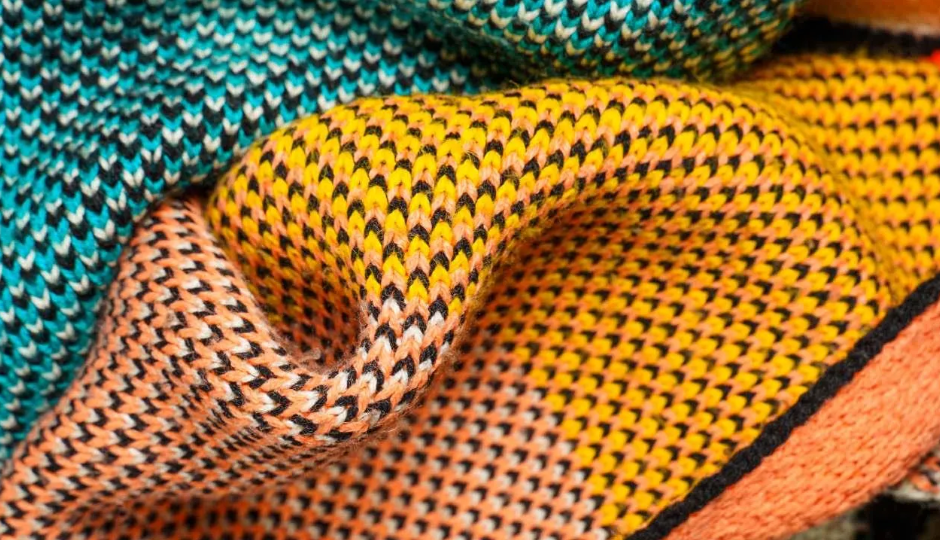
A scarf that twists instead of lying flat. A beanie where the seam never stays centered. A striped fabric where the lines curve instead of running straight. These are all symptoms of spirality — one of the most frustrating quality issues in knitted accessories.
This guide covers spirality (twisting) in knitted scarves and beanies: what causes it, how to measure it (AATCC 179, ISO 16322), acceptable limits, and how to prevent it through yarn selection, knit design, and finishing.
1. What is Spirality?
Spirality is the tendency of knitted fabric to twist or skew out of alignment. When a scarf is laid flat, the edges are not straight — they curve. When a beanie is folded, the seam does not align with the center.
Spirality occurs because yarn has twist liveliness (torque). During knitting, the yarn is fed into the machine under tension. When that tension is released (during finishing or after washing), the yarn tries to return to its natural twisted state, causing the fabric to skew.
- Scarves look crooked and don't hang straight
- Stripes or patterns appear slanted
- Beanies have misaligned seams (seam never stays at the back)
- Products look cheap and poorly made
2. Key Test Methods
2.1 AATCC 179
Skewness Change in Fabric and Garment Twist due to Home Laundering
The most common method for measuring spirality. Fabric is marked, washed, dried, and the degree of skewness is measured as a percentage or angle.
2.2 ISO 16322
Textiles — Determination of spirality after laundering
The international equivalent of AATCC 179. Similar procedure with slightly different sample preparation and measurement standards.
2.3 Simple Factory Test
For quick in-house testing:
- Cut a 50cm × 50cm fabric sample
- Mark a straight line perpendicular to the selvage
- Wash and dry according to expected care instructions
- Lay flat and measure how much the line has skewed
- Calculate twist angle or percentage
3. Measuring Spirality
3.1 Skewness Percentage
Skewness is calculated as:
Example: A 30cm wide scarf with 1.5cm offset has 5% skewness.
3.2 Twist Angle
For beanies and tubular knits, spirality is often measured as the angle of seam deviation from vertical:
3.3 Acceptable Limits
| Product Type | Acceptable Skewness | Premium Target | Reject if > |
|---|---|---|---|
| Plain scarf (solid color) | ≤5% | ≤3% | 8% |
| Striped scarf | ≤3% | ≤2% | 5% |
| Patterned/jacquard scarf | ≤3% | ≤2% | 5% |
| Beanie (seam alignment) | ≤10° | ≤5° | 15° |
| Tubular scarf (knit in the round) | ≤5% | ≤3% | 8% |
4. What Causes Spirality?
4.1 Yarn Twist
The primary cause of spirality is yarn torque (twist liveliness). Yarn is spun with a certain amount of twist — typically "Z" twist for single yarns. This twist creates internal energy that wants to untwist.
- Higher twist = higher torque = more spirality
- Single yarns have more torque than plied yarns
- Plied yarns (2-ply, 3-ply) have balanced torque and significantly less spirality
4.2 Knitting Machine Settings
- Yarn feed tension: Uneven tension increases spirality
- Take-down tension: Excessive pull stretches fabric, increasing twist potential
- Machine gauge: Different gauges affect yarn twist expression
4.3 Fabric Structure
- Single jersey (plain knit): Most prone to spirality
- Rib knits (1×1, 2×2): Less prone — alternating knit/purl balances twist
- Interlock: Very stable, minimal spirality
- Links-links: Moderate spirality
4.4 Finishing
- Relaxation drying: Allows fabric to relax naturally, reducing spirality
- Tenter frame drying: Can set fabric in a skewed state if not properly controlled
- Steam setting: Helps stabilize yarn twist and reduce spirality
5. Spirality by Fiber and Yarn Type
| Yarn Type | Typical Spirality Risk | Why | Recommendation |
|---|---|---|---|
| Single yarn (any fiber) | High (5-10%) | Unbalanced torque | Not recommended for stripes or patterns |
| 2-ply yarn | Low (2-5%) | Balanced torque | Standard for quality knitwear |
| 3-ply yarn | Very low (1-3%) | Very balanced | Premium products, luxury scarves |
| High-twist single yarn | Very high (8-15%) | More torque, more spirality | Avoid unless relaxed after knitting |
| Low-twist single yarn | Moderate (4-7%) | Less torque but still unbalanced | Use for solid colors only |
6. How to Prevent Spirality
6.1 Yarn Selection
- Use plied yarns (2-ply or 3-ply) whenever possible — this is the most effective prevention
- Specify twist direction: "S" twist yarn can be used to counterbalance machine effects
- Request torque-balanced yarns for critical products
- Avoid high-twist singles for wide or striped scarves
6.2 Knitting Parameters
- Optimize yarn feed tension — lower tension reduces spirality
- Reduce take-down tension — less pulling on the fabric
- Use appropriate machine gauge for yarn thickness
6.3 Finishing Treatments
- Relaxation drying: Allow fabric to relax before heat-setting
- Steam setting: Stabilizes yarn twist and reduces torque
- Compressive shrinkage (Sanforization for knits): Mechanically relaxes fabric
- Chemical relaxants: Some softeners reduce spirality
7. Spirality vs. Other Quality Issues
| Issue | Description | Distinguishing Factor |
|---|---|---|
| Spirality | Fabric twists or skews out of shape | Progressive — worse after washing |
| Dimensional instability | Fabric shrinks or stretches | Size change, not shape change |
| Bow or skew (woven) | Weft or warp alignment issues | Fixed defect, not progressive |
| Seam twist | Garment seam rotates around body | Caused by both spirality and cutting |
8. Buyer's Checklist: What to Ask Your Supplier
- ✓ What yarn construction do you use (single, 2-ply, or 3-ply)?
- ✓ Do you test for spirality? What method (AATCC 179 or ISO 16322)?
- ✓ What is your maximum acceptable skewness (%)?
- ✓ Do you use relaxation drying or steam setting to reduce spirality?
- ✓ Can you provide spirality test reports for this product?
9. Spirality Limits by End Use
| End Use | Maximum Skewness | Why |
|---|---|---|
| Fashion scarf (solid color) | ≤8% | Twisting less visible without patterns |
| Daily wear scarf (solid) | ≤5% | Moderate visibility |
| Striped scarf | ≤3% | Twisting very visible on stripes |
| Branded/custom pattern scarf | ≤2% | Pattern alignment is critical |
| Basic beanie | ≤10° twist angle | Seam deviation acceptable if minor |
| Premium beanie | ≤5° twist angle | Seam must stay centered |
10. Cost Implications
Reducing spirality costs more. Here's the trade-off:
| Solution | Cost Impact | Spirality Reduction | Best For |
|---|---|---|---|
| Single yarn (baseline) | $ | Reference | Basic, solid color products |
| 2-ply yarn | +15-25% | 50-70% reduction | Standard quality knitwear |
| 3-ply yarn | +30-50% | 70-85% reduction | Premium/luxury products |
| Relaxation finishing | +5-10% | 20-40% reduction | All products benefit |
| Steam setting | +3-8% | 15-30% reduction | Critical for stripes/patterns |
11. Related Guides from Weave Essence
This guide is part of the Quality Guide (L1) series. It provides in-depth coverage of spirality and twisting for knitted scarves and beanies (L2 depth).
Need help with spirality specifications for your order? Contact our team →